
About Jasti's
A2 Milk
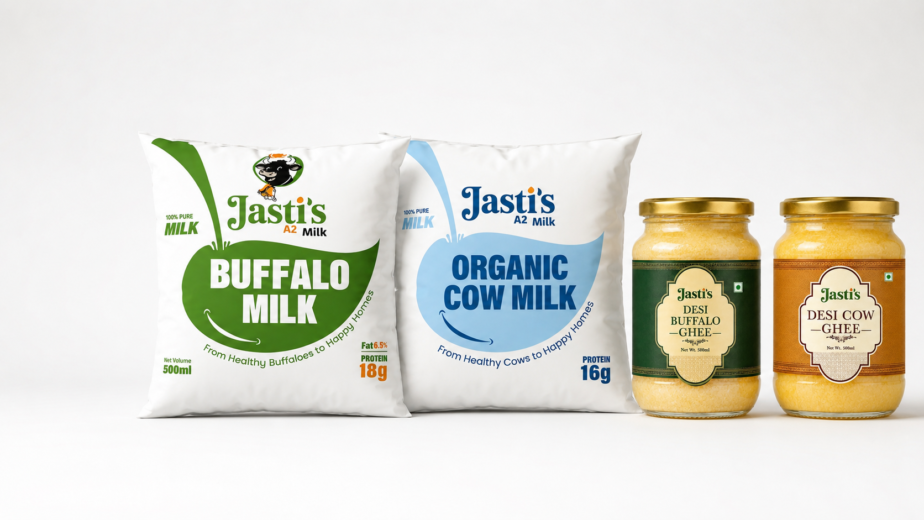
It Began Long Before We Became a Brand. For us, milk was never just a product. It has been part of our family for more than 25 years. My father has spent 25 years working in the milk industry. Twenty-five years of understanding milk. Twenty-five years of understanding farmers. Twenty-five years of understanding animals, feeding, quality, pricing, and what really happens between a farm and the glass of milk placed on a family’s table. Over those years, he learned something that eventually became the foundation of our company: Milk is naturally simple. It is the journey between the animal and the customer that can make it complicated. And after 25 years in dairy, one belief became stronger than everything else: Good milk does not need to be reinvented. It needs to be respected. Somewhere Along the Way, Milk Became Complicated. A cow gives milk. A buffalo gives milk. Nature kept it simple. But the dairy shelf became much more complicated. Skimmed milk, double-toned milk, toned milk, standardized milk, full cream milk, different percentages, different formulations, and different categories. Milk can be separated and standardized so that its fat and other components meet particular specifications. There are legitimate reasons why these categories exist.
But after spending decades around milk, we asked ourselves a different question: What if we simply gave people the milk closer to the way the animal gave it? That question became our philosophy. We do not want to build a complicated ladder of milk. We want to go back to something more fundamental: Buffalo Milk. Cow Milk. Because human beings did not invent buffalo milk. Human beings did not invent cow milk. Nature did. And sometimes progress is not about changing nature more. Sometimes progress is knowing when to stop changing it. What the Buffalo Gives, You Get. This became the simplest way we could explain everything we believe: What the buffalo gives, you get. What the cow gives, you get. It is only one sentence. But behind that sentence are 25 years of experience.
We do not believe the natural richness of milk should be removed simply so that more versions of milk can be created. We do not want to take something valuable away and then ask the customer to choose how much of it they would like back. Our idea is much simpler: Respect the milk that nature produced. Because to us, purity is not about doing more to milk. Purity is about having less reason to change it. But There Was Another Problem We Could Not Ignore. After years in the dairy industry, my father understood that the quality of milk does not begin inside a processing plant. It begins much earlier. It begins with the animal. And even before that, it begins with the farmer. Today, families naturally worry about what is inside the food they consume. They hear about milk adulteration. They worry about substances being added to milk.
They worry about milk powder or other ingredients being used in some dairy products. They worry about antibiotic residues. They worry about unnecessary preservatives. And they wonder: “Is the milk I am giving my family really what I think it is?” We understood that question. Because after 25 years in this industry, we had seen enough to know that trust cannot come from a beautiful packet. It has to come from what happens before the packet. So instead of asking people to simply believe us, we decided that our milk should be able to answer for itself. Our recent buffalo milk analysis recorded 6.7% fat and 9.3% SNF. We Realised Something Else. There are actually two families behind every packet of milk. The family that drinks it. And the family that produced it. For years, dairy businesses have often treated farmers primarily as suppliers. We wanted to look at them differently. Because a farmer cannot continuously produce better milk while being forced to survive on the lowest possible price. Quality has a cost. Good fodder costs money. Balanced nutrition costs money. Animal care costs money. Veterinary care costs money. Maintaining a good farm costs money. And ultimately, somebody has to make those investments. That somebody is the farmer. So if we want better milk for our customers, we cannot begin by asking: “How cheaply can we buy milk?” We have to begin by asking: “How can the farmer who produces our milk live and farm better?” That Is Why We Share Our Success. We pay our farmers fairly. But we wanted to go further. So we made a decision that represents the kind of company we want to become: We share 10% of our company’s profits with our farmers as a bonus. We do not see that as charity. We do not see it as a marketing expense. We see it as sharing value with the people who helped create it. Because when our company does better, we believe the farmer who stood behind that milk should also do better. A better-paid farmer can invest more confidently in quality fodder. Better nutrition. Better animal care. Better farm practices. And a healthier, better-cared-for animal has the foundation to produce better quality milk. That creates a circle we deeply believe in: Take care of the farmer. The farmer takes better care of the animal. The animal gives better milk. The milk reaches another family. And that family helps our company grow. Then part of that success travels back to the farmer. That is how we believe a dairy ecosystem should work. Not a straight line from farmer to company to customer. A circle. We Know the Farmer’s Side Because We Are Farmers Too. Our understanding does not come only from buying milk. We operate our own farm with around 100 buffaloes. That changes the way we see this business. When we speak about feed, we know there is a cost behind it. When we speak about animal nutrition, we know there is daily work behind it. When we speak about milk quality, we know that quality is created long before milk reaches the dairy. And when we speak to farmers, we do not want to speak to them only as purchasers. We speak farmer to farmer. Because we know that every litre begins with an animal that has to be fed, cared for, and respected every single day. Why We Keep Our Milk Limited. There is one consequence to doing things this way. We cannot promise unlimited milk. And we are comfortable with that. We have limited production. So we keep limited customer slots. Because there are two ways to respond when demand grows. One is to find more milk at any cost. The other is to grow only when you can protect what made people trust you in the first place. We choose the second. We would rather tell a customer that a slot is unavailable than compromise the milk to create one. Our goal is not to become the company that sells the most milk. Our goal is to become the company whose customers know exactly why they trust their milk. A Father’s 25 Years Became Our Company’s Philosophy. My father spent 25 years learning this industry. What started as experience eventually became conviction. He learned that milk quality is connected to animal care. Animal care is connected to farmer economics. Farmer economics is connected to how a dairy company chooses to behave. And everything eventually reaches one place: A family’s table. That glass of milk may look simple. But behind it is an animal. Behind the animal is a farmer. Behind the farmer is a family. And in front of that glass is another family trusting us with what they consume every day. That is why we believe milk deserves more responsibility than an ordinary product. So we built our company around four kinds of respect: Respect the farmer who produces it. Respect the animal that gives it. Respect the milk by changing as little as necessary. Respect the family that drinks it. Twenty-five years taught us that the best milk philosophy is probably the simplest one. Nature has already done the difficult part. Our job is to protect it. What the buffalo gives, you get. What the cow gives, you get. From one family that understands milk, to another family that trusts it.