
Benefits of Ghee and How to Make It at Home
What one teaspoon gives you, how buffalo and cow ghee compare, a simple home recipe with exact measures, and what the research says.
One teaspoon of desi ghee gives you about 44 calories and 5 grams of fat. Not much else. That’s the whole story behind the benefits of ghee: they’re real, but small, and the amount you eat matters more than the label on the jar. Below you’ll find what ghee actually does for you, how buffalo and cow ghee differ, and how to make a batch in your own kitchen.
Ghee is nearly all fat. It brings energy, a rich taste and tiny amounts of vitamins A, E and K. Most healthy adults do fine with one to two teaspoons a day, eaten with meals. Got heart disease, high cholesterol or diabetes? Check the right amount with your doctor first.
What is ghee and how is it made?
Ghee is butter that has been cooked slowly until only the golden fat is left. First the milk is turned into butter. Then the butter is heated until the water bubbles away and the milk solids sink to the bottom. You pour off the clear fat on top, and that’s desi ghee. India’s food standard says ghee must be at least 99.7 percent milk fat, with no more than 0.3 percent water.
Cow ghee and buffalo ghee are made the same way. Only the milk is different. “Organic ghee” means the milk came from animals raised under an organic certificate, and “pure ghee” means nothing else was added to it.
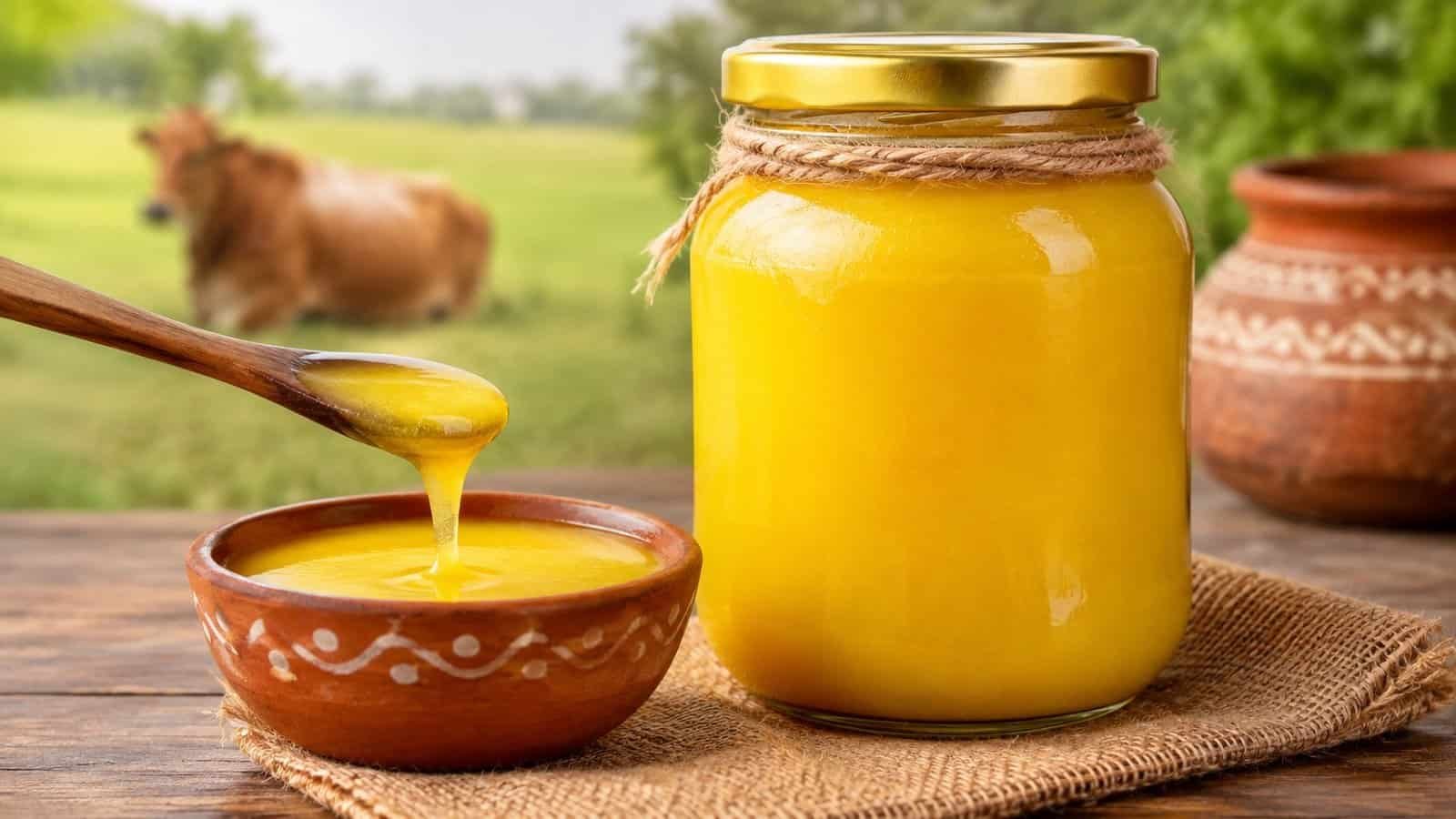
What are the benefits of ghee?
The main benefits of ghee are quick energy, better absorption of vitamins A, D, E and K, and small amounts of A, E and K itself. It has very little lactose and stays stable at high heat. It also makes meals tastier and more filling. Ghee has almost no protein, so use it as a small add-on.
Here is what you can expect from ghee at normal portions, one point at a time.
Does ghee give energy in a small spoon?
Yes. Every gram of fat has 9 calories, so a teaspoon of ghee gives about 44. That helps busy adults, athletes and children who only eat a little at a time.
Does ghee help you absorb vitamins?
It can. Vitamins A, D, E and K need fat to get into your body. A spoon of ghee on a plate of vegetables or dal gives them that fat.
Does ghee carry vitamins A, E and K?
Yes, all three, but in small amounts. A teaspoon has about 42 micrograms of vitamin A. Treat it as a bonus, because fruit, vegetables and eggs do the heavy lifting.
Does ghee contain healthy fats?
About 29 percent of ghee is monounsaturated fat and about 4 percent is polyunsaturated fat. The rest is mostly saturated fat, which is why the portion should stay small.
Does ghee keep you full for longer?
Fat leaves the stomach more slowly than carbohydrate. A little ghee on roti or rice can make a meal feel more filling, so you may snack less afterwards.
How much lactose does ghee have?
Very little. Most of the milk solids and water are removed when ghee is made. Plenty of people who struggle with a glass of milk are fine with a spoon of ghee.
Is ghee good for high-heat cooking?
Ghee is often said to start smoking near 250 °C. That is above what most home cooking needs, so it works for tadka, rotis and shallow frying.
Is ghee good for children?
It helps small children get enough energy from small meals. India’s national feeding guidelines suggest a teaspoon of ghee or oil in each complementary feed from six months.
Can ghee help your cholesterol numbers?
One North Indian study saw better lipid numbers in adults who ate mostly ghee instead of mustard oil. It compared habits and proves nothing, so ask your doctor before changing your fat.
Does ghee make food taste better?
Yes, and that matters. A teaspoon on dal, vegetables or khichdi makes the plate easier to finish. That helps picky eaters, older adults and anyone with a small appetite.
How long does ghee keep?
One lab test used heat to speed up ageing. It predicted about 9 months for cow ghee and 7 for buffalo ghee at 37 °C.
Ghee is not a protein food. A teaspoon has about 0.01 g of protein. It also has no fibre, no carbohydrate and no useful vitamin B12. Get protein from dal, eggs, curd, paneer, milk, fish or chicken, and add ghee for energy and taste.
There’s a simple pleasure too. A teaspoon on dal, vegetables or khichdi makes the plate easier to finish. Consumer Reports spoke to nutrition experts for a balanced look at ghee and saturated fat. They agree it’s tasty, and they remind readers that it’s high in saturated fat.
About 62 percent of ghee is saturated fat. Every 100 grams also holds about 256 mg of cholesterol. If your cholesterol is already high, or you have heart disease, those numbers count. Use a measuring teaspoon and skip the free pour.
How many calories and nutrients are in one teaspoon of ghee?
This table shows ghee per 100 grams and per level teaspoon (about 5 grams). Glance at the protein row. It’s nearly empty.
| Nutrient | Per 100 g | Per teaspoon (5 g) |
|---|---|---|
| Energy | 876 kcal | 44 kcal |
| Total fat | 99.48 g | 5.0 g |
| Saturated fat | 61.9 g | 3.1 g |
| Monounsaturated fat | 28.7 g | 1.4 g |
| Polyunsaturated fat | 3.7 g | 0.2 g |
| Protein | 0.28 g | 0.01 g |
| Carbohydrate | 0 g | 0 g |
| Cholesterol | 256 mg | 13 mg |
| Vitamin A | 840 µg | 42 µg |
| Vitamin E | 2.8 mg | 0.14 mg |
| Vitamin K | 8.6 µg | 0.4 µg |
| Calcium | 4 mg | 0.2 mg |
Per 100 g values come from the USDA entry for ghee, as shown on Wikipedia’s ghee page. The per teaspoon column is our own arithmetic from those values.
Which is better, buffalo ghee or cow ghee?
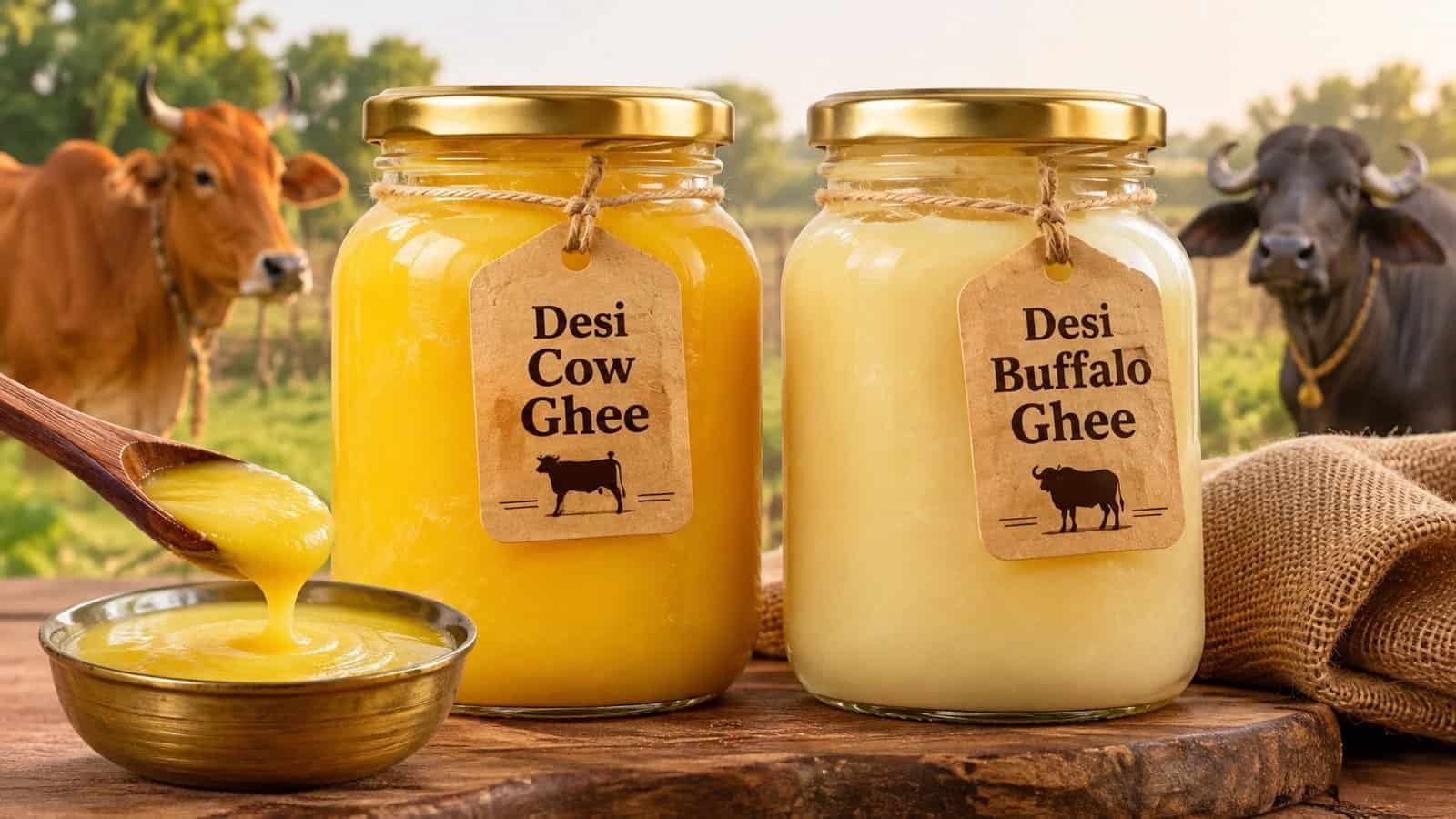
Neither wins on nutrition. Both are almost pure fat, so their fat and protein numbers sit very close together. The real gap starts with the milk. Buffalo milk carries more fat than cow milk, so you need less of it to make a kilo of ghee.
| Point | Buffalo ghee | Cow ghee |
|---|---|---|
| Minimum fat in the milk (FSSAI) | 6.0 percent | 3.5 percent |
| Minimum fat in the ghee (FSSAI) | 99.7 percent | 99.7 percent |
| Protein | Close to zero | Close to zero |
| Vitamins B1 and B12 | None worth counting | None worth counting |
| Minerals | Traces only | Traces only |
| Colour | White, sometimes with a green tinge | Pale golden to yellow |
| Antioxidant test (DPPH, higher is better) | 6.19 percent | 9.24 percent |
| Predicted shelf life at 37 °C | About 7.3 months | About 8.9 months |
| Vitamin A in tested brands | No tested figures found, so ask the maker for a lab report | 2,619 to 3,165 IU per 100 g across 11 brands |
| Common use | Everyday cooking | Rice, roti and a finishing drizzle |
Milk and ghee limits come from FSSAI standards. Antioxidant and shelf life figures come from one 2025 lab study, so treat them as a guide. Cow ghee vitamin A comes from a 2020 Consumer Voice test of 11 brands. Protein, B vitamins and minerals follow the general ghee values in the table above.
Many readers ask about vitamin B1. B vitamins dissolve in water, so they stay with the milk solids and water that get removed during ghee making. The nutrition data we used lists none of them.
Some people say buffalo ghee tastes richer and heavier, and cow ghee tastes lighter. That comes from kitchen habit and has no lab test behind it. Pick the one your family likes and keep the portion the same.
Can ghee help with weight loss or gym goals?
On weight loss, no food burns fat by itself, and ghee is no exception. It packs a lot of calories, so a heaped spoon on every meal can cancel out a calorie deficit. A measured teaspoon that replaces other cooking oil can still fit a weight loss plan. The experts in the Consumer Reports article found little scientific support for the weight loss claims.
At the gym, think of ghee as fuel. A teaspoon holds about 0.01 g of protein, so your muscle-building protein has to come from dal, eggs, curd, paneer, milk, fish or chicken. Ghee just adds calories on days when you train hard.
- Dal and rice with 2 teaspoons of ghee adds about 88 calories to your meal.
- Someone who needs 250 extra calories for training could add 6 teaspoons across three meals. Someone cutting calories can stay at 1 teaspoon a day.
How do you make ghee at home with the bilona method?
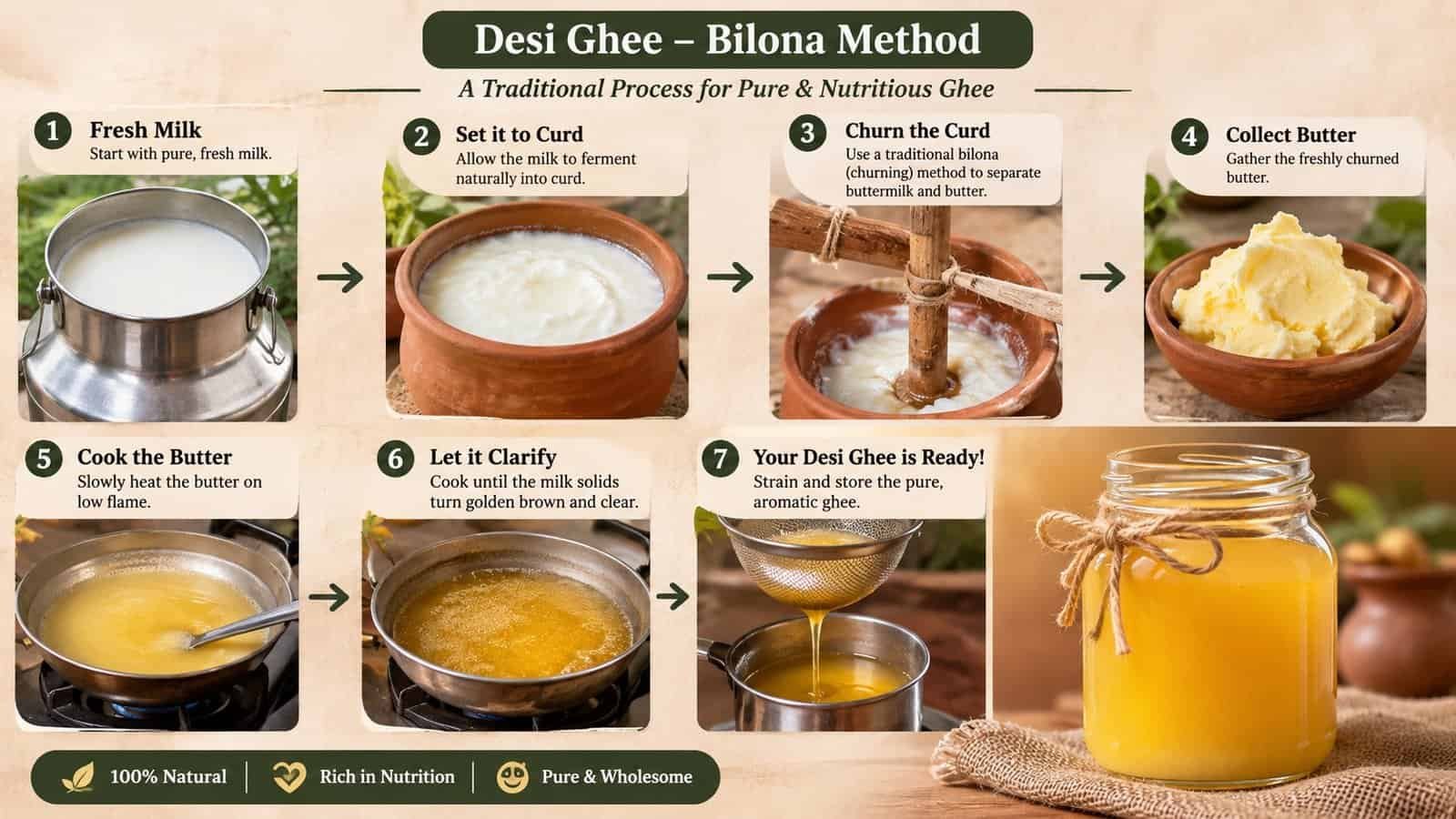
To make ghee with the bilona method, set 4 litres of boiled milk into curd for 8 to 10 hours, churn the curd with 2 cups of cold water for 30 to 40 minutes to collect butter, then heat the butter on a low flame for 25 to 35 minutes. Strain the clear golden fat into a dry jar.
It takes longer than skimming cream, but many families love the flavour. The recipe below uses 4 litres of milk, a batch size that suits a regular kitchen.
What ingredients and tools do you need?
- 4 litres of full-cream buffalo or cow milk
- 4 tablespoons (about 60 g) of fresh, mild curd to start the set
- 2 cups (about 480 ml) of cold water for churning
- A deep pot, a wooden churner (madhani), a heavy-bottomed pan, a steel strainer or clean muslin, and a dry glass jar
What are the steps in the bilona method?
- Boil and cool the milkBoil the milk on a medium flame and let it simmer for 5 minutes. Then cool it to about 40 °C. If you can hold a clean finger in it for 10 seconds, it’s about right.
- Set the curd (8 to 10 hours)Mix in the 4 tablespoons of curd, cover the pot and leave it somewhere warm where it won’t be bumped. Winter slows things down, so give it up to 12 hours.
- Churn the curd (30 to 40 minutes)Pour the curd into a deep pot. Add the cold water one cup at a time and churn at a steady pace. After a while, white butter forms and floats to the top.
- Collect and rinse the butterLift the butter out with your hands. Rinse it twice in cold water and press out the extra water. The buttermilk left behind is good to drink or cook with.
- Heat the butter (25 to 35 minutes)Melt the butter in a heavy pan on a low flame. It will foam and crackle as the water cooks off. Once the crackling stops and the bits at the bottom turn light golden brown, turn off the heat.
- Strain and storeLet the pan sit for 5 minutes. Pour the ghee through a dry steel strainer or muslin into a dry glass jar. Wait until it’s completely cool before you put the lid on.
How much ghee will you get from 2 or 4 litres of milk?
Ghee is almost all fat, so the fat in your milk decides how much you get. We worked these figures out from the minimum fat allowed in milk, assuming you recover 70 to 80 percent at home. Richer milk gives a bit more.
| Milk | Buffalo milk | Cow milk |
|---|---|---|
| 2 litres | About 85 to 95 g ghee | About 50 to 55 g ghee |
| 4 litres | About 170 to 190 g ghee | About 100 to 110 g ghee |
These figures are estimates and not guarantees. For 1 kg of ghee at home, plan on roughly 20 to 25 litres of buffalo milk or 30 to 35 litres of cow milk.
What tips give better ghee at home?
- Keep every spoon, pan and jar bone dry. A few drops of water can spoil a whole batch.
- Stay at the stove and keep the flame low. The browned bits go from golden to bitter in seconds.
- Leave the pan uncovered so the steam can get out.
- On a hot day, chill the set curd for 2 hours before you churn. The butter comes together more easily.
- Keep the jar closed and in a cool, shaded spot, and always scoop with a dry spoon.
Fresh milk makes the best ghee, and the fat in fresh A2 buffalo milk and A2 cow milk decides how much ghee each litre gives.
What do real studies and guidelines say about ghee?
Everything below comes from the published sources listed at the end of this blog. We put it in our own words and didn’t add anything to the findings.
What did the North Indian lipid study find in adults?
A team led by Hanjabam Barun Sharma looked at 200 healthy adults aged 40 and above in North India. They published it in the Journal of Complementary and Integrative Medicine in 2018. People were sorted by how much ghee and mustard oil they used in a month.
The group using the most ghee and the least mustard oil had lower triglycerides, total cholesterol and LDL cholesterol, plus higher HDL. The authors saw this as a possible benefit of eating mostly ghee instead of mustard oil. One caution applies. The study compared eating habits, so it can’t prove that ghee caused the results.
What do India’s feeding guidelines say about ghee for children?
In 2006 the Ministry of Women and Child Development published its Guidelines on Infant and Young Child Feeding. For children from six months old, it advises a teaspoon of oil or ghee in every feed of complementary food. Fat adds energy without adding bulk, and that helps small children who can only eat a little.
The guidelines also say babies can digest fat, and they suggest adding ghee to a child’s first porridge. Ghee stirs easily into soft homemade food, so it suits this advice well.
How does ghee fit into a normal day?
Here are a few ordinary moments where a teaspoon of ghee makes sense.
- The office lunch. A teaspoon on dal and roti makes a plain meal taste richer. The sabzi goes down easier, and the fat helps your body take in the vitamins from the vegetables.
- The training day. After a workout, egg bhurji or paneer rice with 1 to 2 teaspoons of ghee adds calories for recovery. The protein still comes from the egg or paneer.
- The tadka pan. Ghee takes the quick, hot heat of tempering cumin and garlic without trouble, and the flavour lands right in the dal.
- The toddler’s khichdi. One teaspoon in each bowl matches the national feeding advice and adds energy to a small portion.
- The school child who eats little. A smear on a roti or a spoon in rice adds about 44 calories with almost no extra food on the plate.
For adults and children alike, one measured teaspoon with a normal meal is enough.
When is the best time to eat ghee?
No study has found one best hour for ghee. The easy rule is to have it with a meal you were already going to eat.
- Breakfast. Half to one teaspoon on warm roti, idli, dosa or porridge gives you a little steady energy for the morning.
- Lunch. One teaspoon on dal or rice works well, because lunch is often your biggest meal.
- Dinner. Keep it to about half a teaspoon if heavy food keeps you up at night.
- Empty stomach. Some traditions take ghee in warm water first thing in the morning. The evidence is thin. If it makes you queasy, have it with food instead.
Start with one teaspoon a day. Go up to two only if you’re active and eat little other fat. Children should have ghee with their meals and skip it between meals.
What are some simple ghee recipes to start with?
- Jeera rice. Warm 1 teaspoon of ghee, add half a teaspoon of cumin, and stir in 1 cup of cooked rice.
- Dal tadka. Fry cumin, garlic and one dry red chilli in 1 teaspoon of ghee. Pour it over a bowl of hot dal.
- Ghee roti. Spread half a teaspoon of ghee on each roti while it’s hot.
- Toddler khichdi. Cook a quarter cup of rice and a quarter cup of moong dal until very soft. Mash it and stir in 1 teaspoon of ghee.
How do you choose pure ghee?
Read the label before you trust the colour. Breed, feed and season all change how yellow ghee looks, so deep yellow doesn’t prove it’s pure.
- Find an FSSAI licence number on the pack.
- Make sure the ingredient list says only ghee or milk fat.
- Look for a batch number and a best-before date.
- If the pack says organic ghee, ask to see a lab report.
- Smell it. Fresh ghee smells clean and nutty. A sharp or sour smell means it has turned.
Both pure buffalo ghee and cow ghee should pass every check above.
What are the most common questions about ghee?
What are the benefits of desi ghee?
Desi ghee gives you concentrated energy, small amounts of vitamins A, E and K, and very little lactose. It stays stable in hot cooking and makes dal, rice and vegetables taste richer. The benefits are modest, and ghee is high in saturated fat, so one to two teaspoons a day is a sensible limit for most adults.
Does ghee have protein?
Almost none. Ghee is about 99.5 percent fat, and 100 grams holds only around 0.28 grams of protein. The milk proteins are removed along with the milk solids. For protein, rely on dal, eggs, curd, paneer, milk, fish or chicken, and treat ghee as a source of flavour and calories.
Does desi ghee increase cholesterol?
It can in some people. Ghee holds cholesterol and about 62 percent saturated fat, which may raise LDL. One North Indian study found better lipid numbers in adults who ate mostly ghee, but it only compared habits and proved nothing. If your cholesterol is high, ask your doctor how much ghee is safe for you.
Does desi ghee help in weight loss?
Not on its own. No food melts fat, and one teaspoon of ghee carries about 44 calories. It can sit inside a weight loss plan if you measure it and use it instead of other cooking fat. A heaped spoon on every meal can add enough calories to stall your progress.
Can babies have ghee?
Yes, from six months, in small amounts mixed into homemade food. India’s national feeding guidelines suggest about a teaspoon of ghee or oil in every complementary feed, because fat adds energy without bulk. Begin with less if your baby is new to solids, and ask your paediatrician what suits your child.
How should I have desi ghee in the morning?
Have it with food. Spread half to one teaspoon on warm roti, idli or dosa, or stir it into porridge. Some traditions drink ghee in warm water on an empty stomach, but no strong study backs that. If it leaves you feeling heavy or queasy, take it with a meal.
Does ghee expire?
Yes, though it lasts a long time. Air, moisture, heat and light slowly turn it rancid. Store it in a clean, dry, airtight glass jar away from sunlight and scoop with a dry spoon. A sour, sharp or paint-like smell means it has gone bad. On packed ghee, check the best-before date.
Does ghee have lactose?
Only traces. Lactose sits in the watery part of milk and in the milk solids, and ghee making removes most of both. Many people who are sensitive to milk handle small amounts of ghee well. A true milk allergy is a different matter, so check with your doctor before eating ghee if you have one.
How do you make desi ghee at home?
Boil milk, cool it to about 40 °C and set it as curd overnight with a spoon of old curd. Churn the curd with cold water to get butter. Heat the butter on a low flame for 25 to 35 minutes until golden, then strain it into a dry jar. Four litres of milk gives roughly 100 to 190 grams.
Which is better, buffalo ghee or cow ghee?
Neither is better for everyone, since both are almost pure fat. Cow ghee is pale golden and milder, and one lab study predicted a slightly longer shelf life for it. Buffalo ghee is whiter and tastes richer. Choose by taste and cooking use, and keep to the same one to two teaspoons a day.
Does desi ghee have vitamin B12?
No useful amount. Water-soluble B vitamins, including B1 and B12, stay mostly with the milk solids and water, and ghee making removes both. The vitamins in ghee are the fat-soluble ones, mainly A, E and K, in small amounts. Get your B12 from milk, curd, eggs, fish or meat.
Should you eat ghee every day?
For most healthy adults, yes, in small amounts. One measured teaspoon with a meal is a fair place to start. It adds flavour, energy and a little vitamin A, E and K. Pick buffalo or cow ghee by taste, read the label before you buy, and keep an eye on the fat in the rest of your diet. If you have a health condition, let your doctor set the amount.
Disclaimer
This blog is for general information and is not medical advice. Talk to your doctor or a registered dietitian before changing your diet, especially if you have a health condition or are feeding a baby. Last updated November 2026.